Renowned Kenyan Author Ngũgĩ wa Thiong’o Dies at 87
Celebrated Kenyan author, scholar, and activist Ngũgĩ wa Thiong’o has passed away at the age of 87. His family announced his death on the evening of Wednesday, 28th May 2025, with a heartfelt tribute: “He lived a full life, fought a good fight.” “It is with a heavy heart that we announce the passing of […]

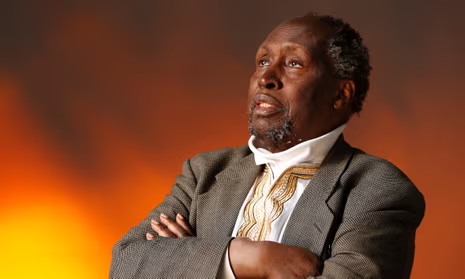
Celebrated Kenyan author, scholar, and activist Ngũgĩ wa Thiong’o has passed away at the age of 87.
His family announced his death on the evening of Wednesday, 28th May 2025, with a heartfelt tribute: “He lived a full life, fought a good fight.”
“It is with a heavy heart that we announce the passing of our dad, Ngũgĩ wa Thiong’o,” his daughter, Wanjiku wa Ngugi, shared in a Facebook post on Wednesday night.
“As was his last wish, let’s celebrate his life and his work. Rîa ratha na rîa thŭa. Tŭrî aira!”—a Gikuyu expression that loosely translates to “With joy and sorrow. We are proud.”
Plans for public tributes and memorial services will be announced in the coming days. “The family’s spokesperson, Nducu wa Ngugi, will announce details of his celebration of life soon,” Wanjiku added.
Ngũgĩ was a towering figure in African literature, whose impact transcended borders, languages, and generations.

He was best known for novels such as A Grain of Wheat, Petals of Blood, and Devil on the Cross, and was a fierce advocate for writing in African languages. Throughout his life, Ngũgĩ opposed colonial and neocolonial systems of oppression.
Born in 1937 in Kamiriithu, Limuru, his writing was deeply rooted in Kenya’s struggle for independence and its postcolonial identity.
A pivotal moment came in 1977, when his radical play Ngaahika Ndeenda (I Will Marry When I Want), performed entirely in Gikuyu, led to his imprisonment without trial by the Moi regime.
The experience profoundly shaped his future work. From that point on, he abandoned English in his writing, choosing instead to write in Gikuyu and later translate into other languages.
Ngũgĩ spent many years in exile, teaching at top universities including Yale and the University of California, Irvine.
Despite his physical distance from home, he remained closely connected to Kenya through his language, activism, and unwavering stance against injustice.
Tributes have already begun to pour in from across the globe. Writers, scholars, and admirers are remembering him not only for his literary brilliance but for his steadfast commitment to truth, justice, and cultural pride.
Reporter
0 Comments
Leave a Comment